
Do I need a humidity extractor fan in my kitchen?
Kitchens naturally produce large amounts of moisture every day. Boiling pans, steaming vegetables, simmering sauces, kettles, dishwashers and even drying clothes indoors all release water vapour into the air.
In a kitchen that’s well-ventilated, this moisture is dispersed before it becomes a problem. However, when humidity levels remain high, condensation can form on windows, walls, ceilings and colder surfaces throughout the room.
Here, we explore the effects of humidity in the kitchen, the building regulations around ventilation and the solutions that will keep your kitchen feeling fresh, clean and well cared for.
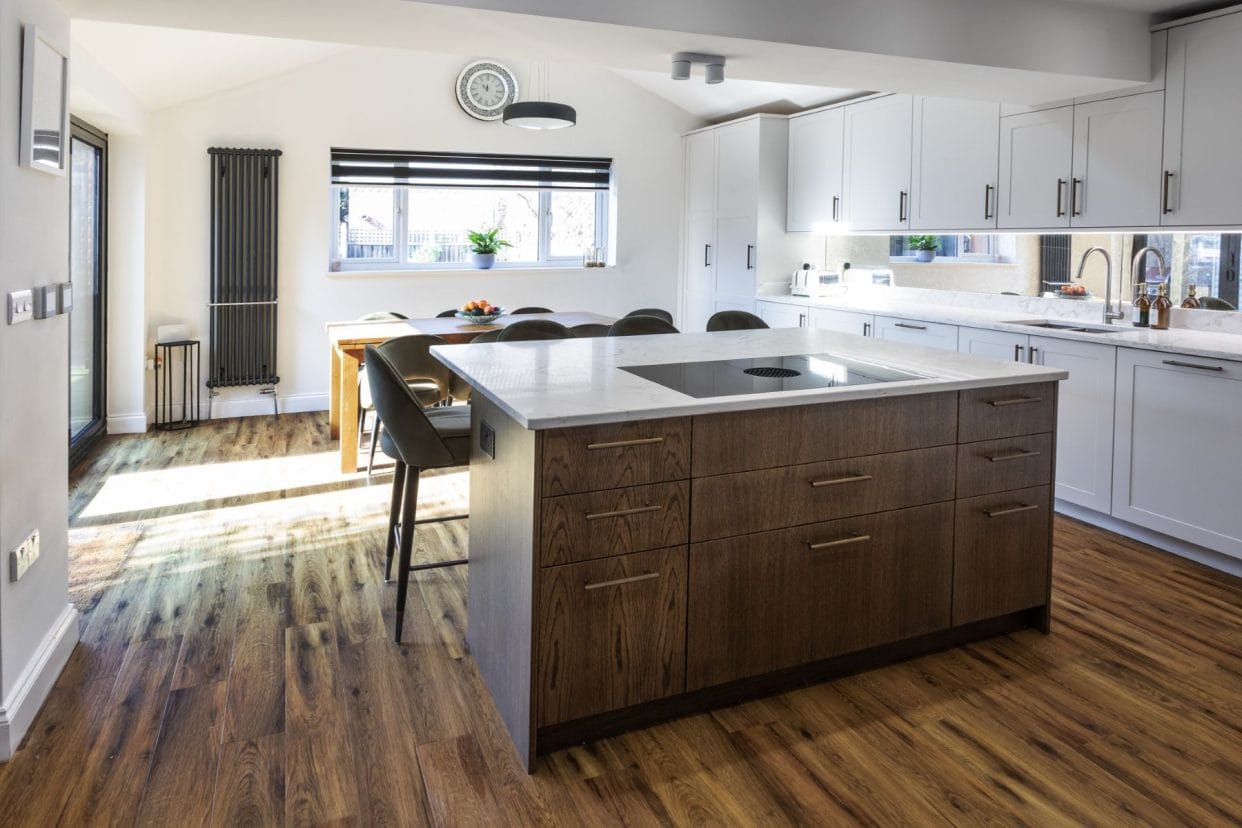
Why can humidity become an issue?
Over time, excessive humidity can lead to:
- Condensation on windows and doors that can lead to mildew growth
- Damp patches on walls and ceilings
- Unpleasant odours
- Reduced indoor air quality
Humidity can also affect the longevity of your kitchen cabinetry and work surfaces.
Excessive humidity causes wood and engineered materials to absorb moisture, which can lead to swelling and warping over time. It can affect painted finishes and cause rust on cabinetry hardware.
It can also degrade the sealants on natural stone worktops, leading to stains and the risk of bacterial growth.
Are extractor fans required by Building Regulations?
Building Regulations require kitchens to have adequate ventilation to help remove moisture, cooking vapours and airborne contaminants.
The exact requirements depend on the type of property, the kitchen layout and whether ventilation is provided through intermittent extraction (such as an extractor fan) or continuous mechanical ventilation (which works constantly at a ‘trickle’ speed).
For a new kitchen in the UK, Building Regulations (Approved Document F) require mechanical extract ventilation to remove moisture and cooking odours.
For example, cooker hoods located above a hob must extract at least 30 litres per second to the outside. If placed elsewhere, the minimum extraction rate is 60 litres per second.
Key ventilation standards:
- Ducting requirement: Systems must vent directly outside where possible
- Background ventilation: Kitchen windows (or walls) must include trickle vents
- Purge ventilation: Opening windows are required to help ‘purge’ the room of heavy smoke or steam, and should typically have an area of at least one tenth of the room’s floor space
- Noise and efficiency: Fans must operate quietly and be energy-efficient
There is no one-size-fits-all answer. A small kitchen with an opening window may have different requirements from a large open-plan kitchen in a well-insulated modern home.
When designing a new kitchen or renovating an existing one, ventilation should be considered alongside factors such as room size, the appliances, insulation levels and the overall ventilation for the space.
Professional design input will ensure that a new kitchen meets the required ventilation requirements.
How to manage humidity in your kitchen
There are several ways to reduce humidity and condensation in your kitchen:
Open windows and doors
The simplest solution is natural ventilation. Opening windows or doors during and after cooking allows moisture to escape and fresh air to circulate. Obviously, this is more practical in the spring and summer months.
Improve whole-home ventilation
Some homes benefit from mechanical ventilation systems that continuously remove moist air throughout the property.
These systems can complement kitchen extraction but are rarely a substitute for effective extraction directly from the cooktop.
Manage indoor moisture sources
Simple habits such as using pan lids, avoiding drying clothes indoors and running your dishwasher on an energy-efficient setting can help reduce the amount of moisture released into the atmosphere.
Install effective kitchen extraction
For most kitchens, the most effective solution is an extraction system designed to remove steam, grease particles and cooking odours at source.
This is particularly important in open-plan spaces where moisture can quickly spread into the adjacent living areas.
What types of kitchen extractor fan are available?
Modern kitchen extraction systems are available in several forms:
Traditional cooker hoods
These can be wall-mounted, island and ceiling-mounted. These systems capture steam and cooking vapours above the hob and remove them either through external ducting or recirculation filters.
Integrated extraction systems – BORA cooktops
Increasingly, homeowners are choosing integrated extraction systems that combine cooking and extraction into a single appliance.
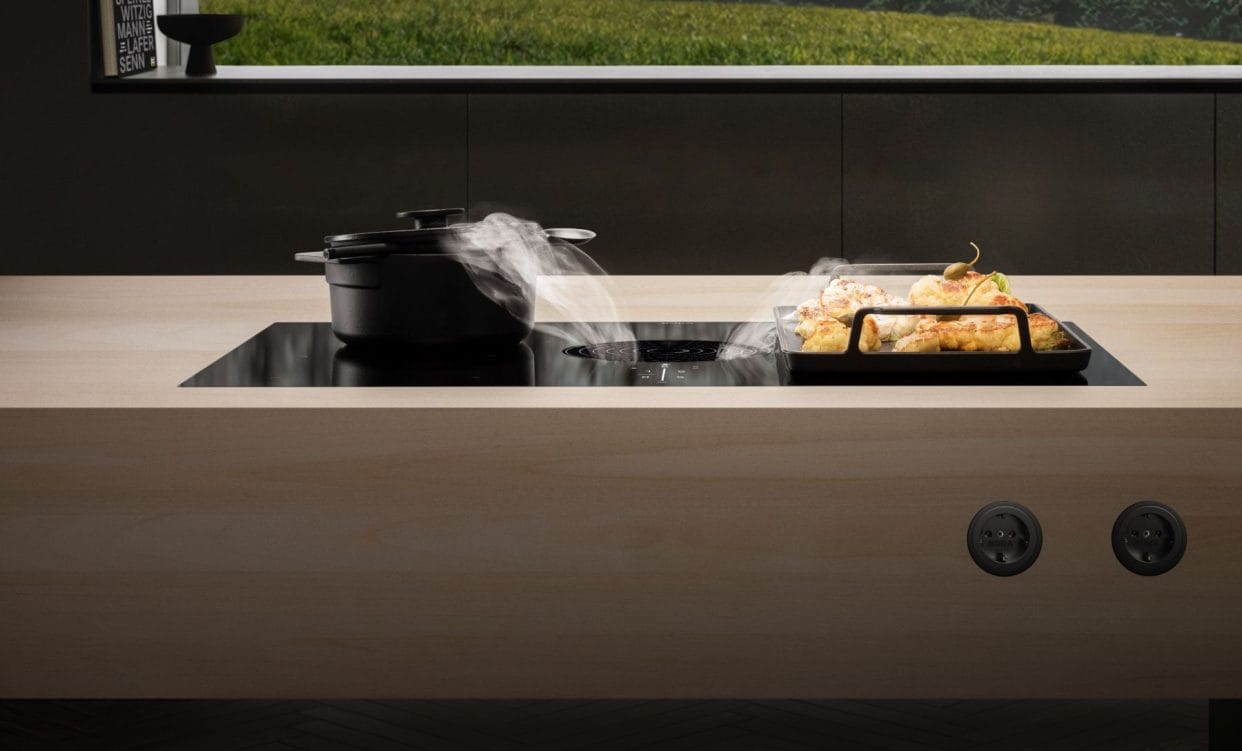
One of the most advanced examples is the BORA range of cooktop extractors, which extract steam and cooking vapours directly at hob level before they can rise into the room.
BORA hobs are not only aesthetically pleasing with their streamlined design in a choice of high-gloss or ‘Rough’ finish; they provide highly effective extraction performance.
Their minimalist styling is extremely easy to clean, plus they are very easy to use with intuitive touch screen controls.
Understanding ducting and recirculation
When choosing the right extraction system, it’s important to understand the difference between ducted and recirculating extraction.
- Ducted extraction: Removes moist air from the property through external ducting
- Recirculating extraction: Filters grease and odours before returning air to the room
Recirculating systems can be highly effective at managing odours and grease. However, they do not remove water vapour from the home. Therefore, some kitchens may need additional ventilation to sufficiently control humidity and satisfy Building Regulations requirements.
Why ducting matters
Even the best extractor system can underperform if the ducting is poorly designed or incorrectly installed.
Ducting should be:
- Correctly sized
- Properly insulated where required
- Kept as short and straight as possible
- Installed using high-quality components
- Correctly sealed at all joints
Poor quality or poorly fitted ducting can allow condensation to form within the duct itself. In some cases, this water vapour can cool, condense and find its way back into the room.
This is why professional installation is every bit as important as choosing the right appliance.
How do kitchen materials affect condensation?
The materials used within your kitchen can also influence how kitchen humidity behaves.
For example, natural stone flooring creates a beautiful and traditional finish. However, stone tends to remain cooler than the surrounding air, particularly during the winter months.
When warm, moist air comes into contact with a colder surface, condensation forms more readily. As a result, kitchens with stone floors may experience more visible signs of condensation.
This doesn’t mean stone flooring should be avoided, it simply highlights the importance of considering all aspects of the kitchen design, including the materials used, alongside adequate ventilation.
Expert guidance
At Great British Kitchens & Interiors, we understand that every kitchen has unique requirements, which will depend on the space itself, materials chosen and choice of appliances.
We’ll consider every aspect of your kitchen during the design process, including ventilation, humidity control and extraction.
Whether you’re planning a completely new kitchen, upgrading existing appliances or considering options such as BORA cooktop extraction, our team can help ensure your kitchen remains a comfortable, healthy and enjoyable environment for years to come.
